
Stubborn Propeller Blade
From Mike Loftus's Facebook account
28.09.2020
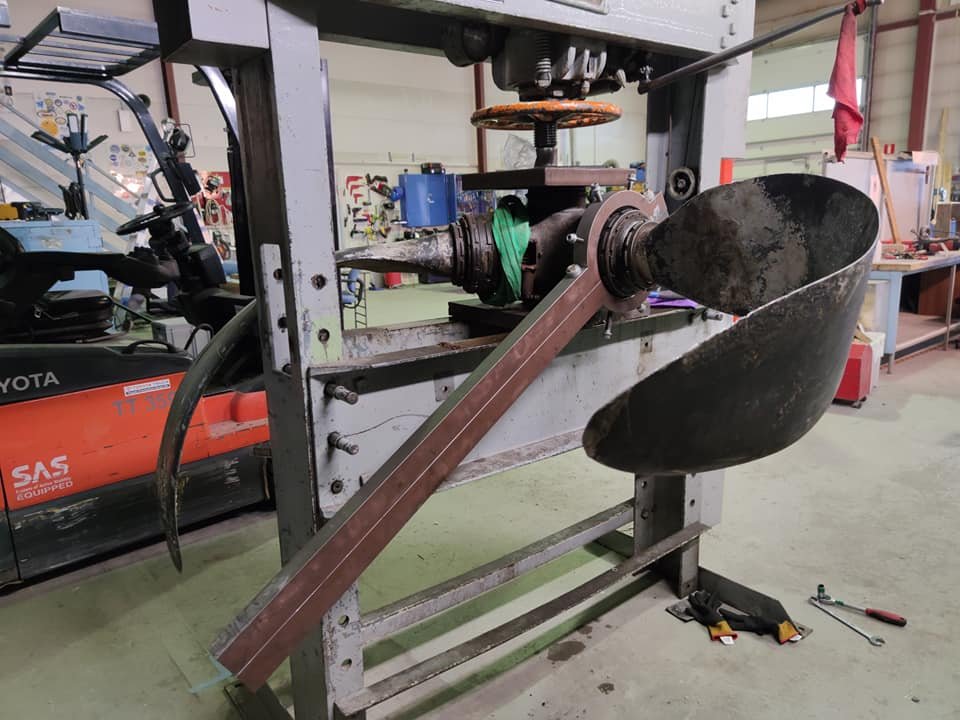
The first attempt resulted in the blade being turned 180 degrees before it stopped. Everything was stuck solid. It was decided to use another hub and other, straight blades. The original unit was thus left with one blade pointing the wrong way.
As the aircraft was to be displayed as a separate exhibition, there was a wish to be able to display the original propeller unit in order to show the forces present in a crash, even in water.
Over all the years on land the blade stuck even more firmly. Repeated attempts were made to get it back into the right position using home-made tools, without success.
Click on the pictures for a larger view.


...


11.06.2020
Click on the pictures for a larger version.
When "Yellow 3" made an emergency landing on the sea in Risværsundet, the propeller blades were bent backwards when meeting the water. It shows the forces that occur when an object meets the water at high speed.

Attempts were made to detach the blades from the propeller hub, without much success. One blade was rotated 180 degrees before it stopped. The others did not move at all.

Since then, various attempts have been made with various deceptive methods to get the blade twisted back to its original position, but it is still 180 degrees wrong compared to the other two.
After applying various miracle chemicals for a long time to solve possible corrosion that may be holding back, it was time yesterday to work hard. Raw power in combination with power X long arm should be tried.


Two of the propeller blades were wrapped in foam rubber to be protected from further damage, and the whole unit was strapped to a pallet stack. A concrete block was tied to the opposite end to serve as a counterweight.
The power became too much, and the forklift lifted the entire arrangement off the ground without the blade giving inn.
More counterweight is to be put on, but what the result will be is not known, because the reporter had to leave the arena. If they did succeede, a new report will be published in the near future.
The idea is that the propeller will be exhibited together with the aircraft to show what can happen when the propeller meets the water during an emergency landing. Therefore, it is important that all blades are bent alike. If one were to point in the opposite direction of the other two, we would have at least one, maybe two, explanatory problems.
Latest update: They managed to turn the propeller blade just a bit, but then the arm of the tool went into the asphalt.
They have not given up yet, alternative solutions are now being looked for.
So far: 1 - 0 for the propeller.
...