Sea King - Collected Material

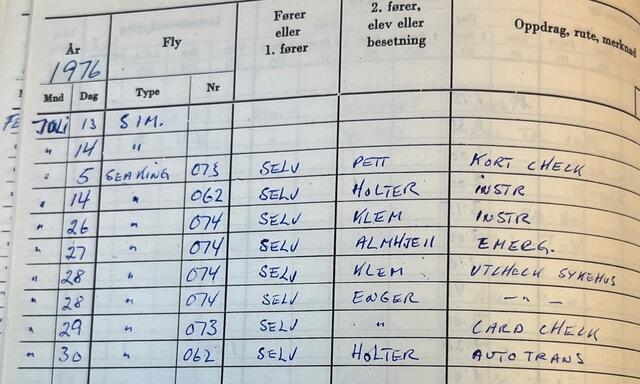
Dear colleagues! At the risk of repeating the theme, it is a pleasure to see how many threads are coming together around next Wednesday! Posters and lecterns, minner.no, planning of food and drink, reception and guests, documents, pictures, seating plans and much, much more! And Wednesday is only the start; from there the museum assignment quickly picks up pace. And many people have been involved in collecting the "interior" of the Sea King, which is now so complete and authentic that you can almost just climb into the helicopter and take off! As we will be able to tell, and as part of what is being collected "around" it, is for example the knowledge that this helmet belongs to a particular crew function, and will be found in one very specific place, for one very specific reason. This is important for us to know so that it is presented correctly, and it is a good and important part of the story we will be able to pass on. Other documentation can be found elsewhere, such as in logbooks. Which helicopter was it that rescued so-and-so from a mountain top, or hoisted someone up from a fishing boat, many years ago? The logbook pages below will in time also become part of our cultural heritage, but show by way of example a pilot who started straight away as captain/commander on the Sea King here in Bodø in early 1973, after the course in the United Kingdom in 1972. And through no fewer than seven handwritten logbooks one can follow the whole career, from flying school in Norway in 1948 (Fairchild Cornell, and we have one at the museum), to the Harvard and Spitfire (which we also have), Norseman (which we have) and a number of other aircraft types that we do not have, and on to helicopters such as the Bell UH-1B (which we have) and then as one of the very first captains and pilots on the Sea King, here in Bodø. And behind every line there are hours of planning, execution, routines, perhaps drama, and hopefully a happy and, now and then, an unhappy outcome, before the debriefing and cycling home for dinner when the watch or the working day was over. I wish you all a really good weekend, and thank you each and every one for a tremendous effort in the week that has passed. Best wishes, Rolf :-)

11.03.2024
11/03/2024
09:59
Arvid Martinussen

...

© Rolf Liland (RL)
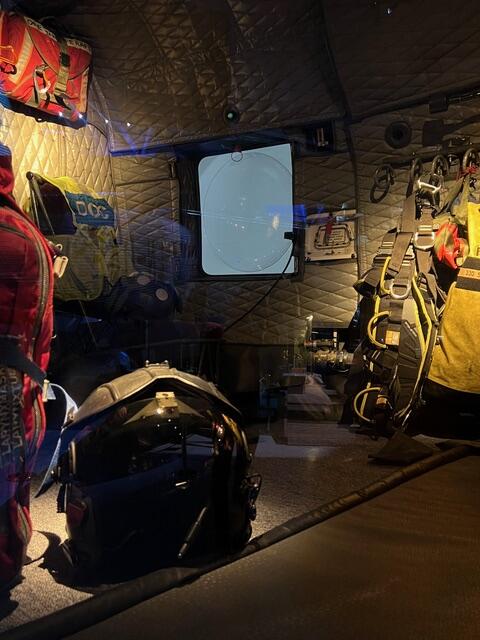
Through the Plexiglas covering the cargo opening there is a good view of what is inside the helicopter.
© RL
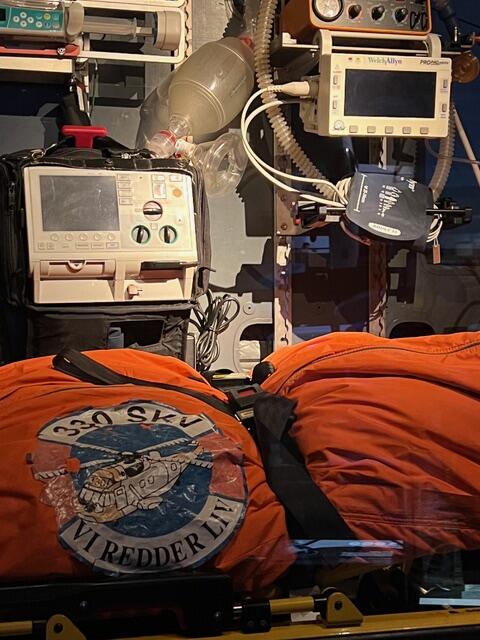
Some of the equipment that a Sea King in operational mode carries with it.
© RL
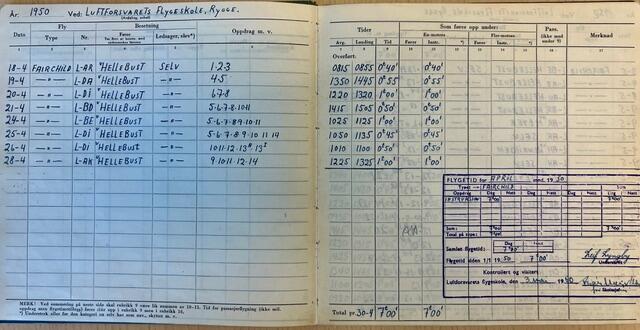
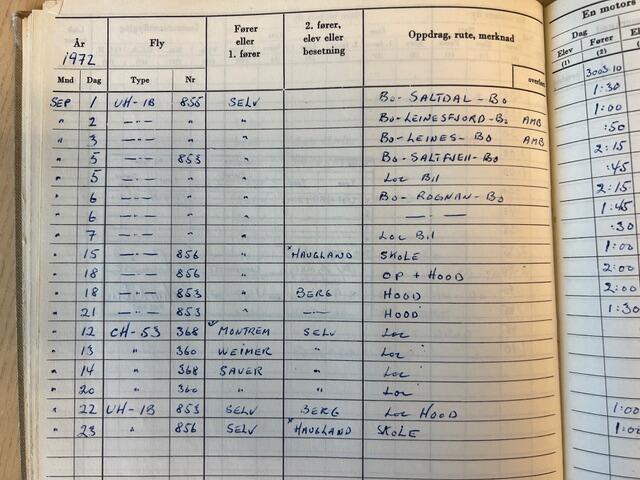
The first instruction hours at "Gamle Rygge" airfield. The pages tell of the school programme, progression, flight time, the instructor's name and total flight time. It does not say that this was also a selection flight, and after two "pink" trips one could quickly be sent home.
© RL
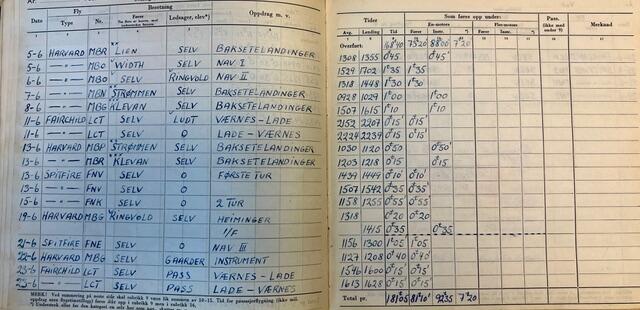
And after what would have been a cavalcade of the Air Force's jet aircraft and large and small transport aircraft, we see the Bell helicopter, with Bodø as its base. Only a couple of them were stationed here, in support of the air station generally, and to be able to pick up fighter pilots in distress more quickly. But we also see that the pilot gains first-hand experience with a really heavy transport helicopter, through four trips with the American-built Sikorsky CH-53.
© RL
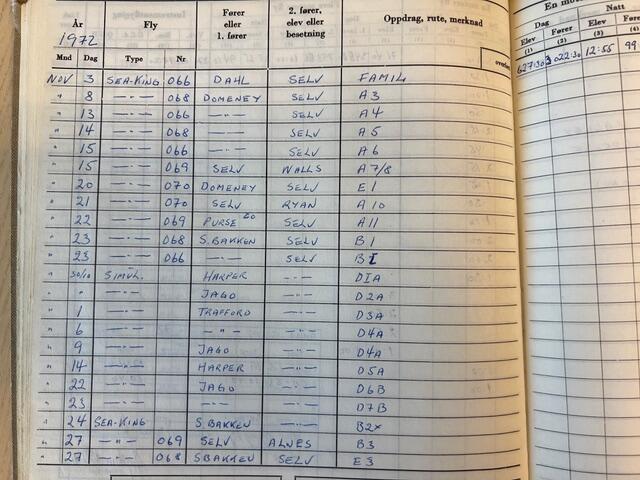
And then, in November 1972, over 51 years ago, with enormous experience, he goes to the UK, where we follow the practical part of the school and training programme. One can assume that the whole of October went to theory lessons and exams. After a British conversion course, pilots know almost enough to build a helicopter themselves, as the joke goes…
© RL
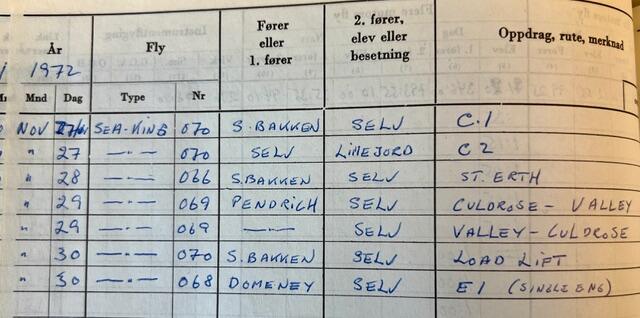
We also see that the training takes place on the Norwegian helicopters 066, 068, 069 and 070, as well as in the simulator, and "mission" refers to the different trips/training goals/learning goals in the school programme. Somewhere there is probably also the textbook...
© RL
Then there is navigation training at the end.
© RL
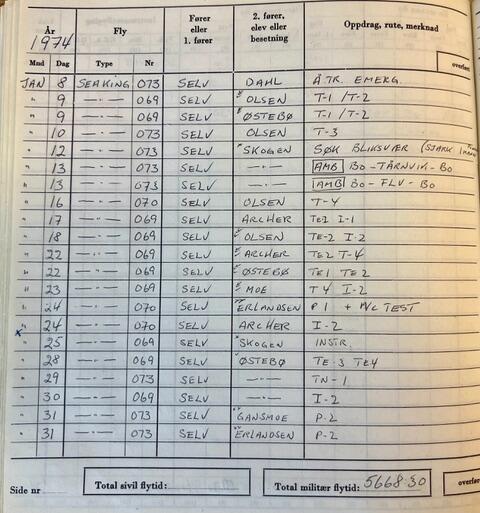
In March 1973 the pilot is back in Norway, now as captain, and presumably in the Air Force's own training programme where crews train together in various ways. The co-pilots or students will no doubt also have interesting backgrounds and experience of their own as they enter the rescue helicopter service.
© RL
One can sense that the training continues on new pilots, mixed in, as we see, with both search (fishing boat, 1 man found) and ambulance missions.